 Quick Pay


-

TVS Credit
-

Two Wheeler Loans
-

12 October, 2026
Calculating the bike mileage accurately helps you understand the performance of your bike and if it needs any repair. A well-maintained bike with good mileage can save you money in the long run by reducing fuel costs and minimising wear and tear. Understanding the bike mileage can help you decide the ideal type of bike you would want to purchase, diagnose if something is wrong with your current bike or understand the resale value of a bike.
In this blog, we will break down what bike mileage is and different methods to calculate it. By following these steps, you can ensure that your bike runs smoothly while optimising fuel consumption.
What is bike mileage?
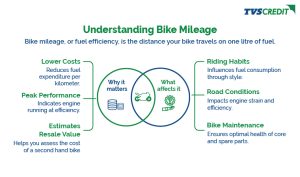
Bike mileage, also known as fuel efficiency, is the number of kilometres a bike can travel using one litre of fuel. It is an important factor for riders as it directly impacts fuel costs and the overall performance of the bike. Good mileage means your bike is running efficiently, consuming less fuel, and saving you money over time.
Several factors affect mileage, such as riding habits, road conditions, and bike maintenance. But you can improve your bike’s mileage with smooth acceleration, proper tyre pressure, and regular servicing. On the other hand, aggressive driving habits, faulty bike components, and poor maintenance can reduce the mileage.
Good to Know: Using premium fuel does not always mean better mileage; check your bike’s manual for fuel recommendations.
Bike mileage versus bike Average
Many people use the terms “bike mileage” and “bike average” interchangeably, but they are not exactly the same. Here’s how they differ:
1. Understanding the terms
| Term | Definition |
| Bike Mileage | The exact distance a bike can travel per litre of fuel under ideal, controlled conditions. |
| Bike Average | A general estimate of fuel efficiency based on real-world conditions, including different riding styles, road types, and traffic. |
2. Key differences
| Factor | Bike Mileage | Bike Average |
| Measured Under | Ideal test conditions (smooth roads, no traffic, constant speed) | Real-world conditions (city roads, highways, different speeds) |
| Accuracy | More accurate but not always achievable in daily use | More practical and represents actual fuel efficiency |
| Example | A manufacturer claims a mileage of 100 km/l in a test environment | In real-world use, the same bike may deliver an average of 80 km/l |
3. For example
A bike manufacturer tests a bike in a perfect environment:
- Smooth roads
- No traffic
- Steady speed
- Only one or two passengers
Under these conditions, the bike gives a mileage of 100 km/l.
But when you ride the same bike in real conditions:
- City traffic with frequent stops
- Different speeds on highways and streets
- Varying loads (more passengers, luggage)
The actual mileage reduces, and the bike average may be around 80 km/l.
Different methods of calculating bike mileage
There are several ways to calculate a bike’s mileage. Here are the three of the most common-used methods:
1. Full tank method
This is one of the most commonly used methods to measure bike mileage.
- Fill your bike’s fuel tank to its full capacity or on auto cut and note down the odometer reading (the total kilometres your bike has travelled so far).
- Ride your bike as usual for a few days or kilometres, ensuring you cover a good distance to get an accurate measure.
- Refill the tank to full again and note how much fuel was added.
- Check the new odometer reading and subtract the initial reading to get the total kilometres travelled.
- Use this formula to calculate the bike mileage:
Mileage (km/l) = (New Odometer Reading – Initial Odometer Reading) / Fuel Refilled
2. Reserve-to-reserve method
This method helps in estimating mileage without completely filling the tank.
- Start by noting the odometer reading when your bike’s fuel level reaches the reserve mark.
- Fill the tank with a measured quantity of fuel. Ride normally until it reaches the reserve again.
- Note down the amount of fuel added to reach the reserve level and the new odometer reading.
- Apply the same mileage formula to determine the bike’s efficiency.
Good to Know: This method may not be as precise as the full tank method since reserve fuel levels can slightly vary.
3. Trip metre method
This is a simple and convenient way to track mileage over a period of time.
- Reset your bike’s trip meter to zero after a full tank refill.
- Ride as usual, covering a reasonable distance under normal conditions.
- When refilling, note how much fuel is added and check the trip meter reading.
- Use the mileage formula to get an estimate.
Tip: If your bike does not have a trip meter, you can manually track distances using your odometer readings.
Step-by-step guide on how to calculate mileage of a bike
- Choose a method (Full tank, reserve-to-reserve, or trip Metre) based on your convenience.
- Ride under normal conditions to get a realistic estimate.
- Use a bike mileage calculator or manually apply the mileage formula.
- Repeat the process a few times to get a more accurate average.
Tips to improve bike mileage accuracy
- Always measure mileage on similar riding conditions (e.g., city or highway).
- Maintain proper tyre pressure for better fuel efficiency.
- Avoid overloading the bike.
- Ensure regular servicing and use quality fuel.
Common mistakes to avoid when calculating bike mileage

- Not filling the tank to the exact level each time – You can use auto-cut at the fuel station each time you refill.
- Measuring after short rides instead of a complete fuel cycle – Ensure you ride enough distance before taking measurements to get an accurate reading.
- Ignoring tyre pressure and engine condition – Check tyre pressure regularly and get your bike serviced to maintain optimal fuel efficiency.
- Not resetting the trip metre properly – Always reset the trip metre or note odometer readings correctly before starting the mileage test.
Importance of knowing your bike’s mileage
Understanding how to calculate mileage per km helps in better budget planning and maintaining bike performance. Regularly checking the bike mileage using a bike mileage calculator helps you keep track of the bike’s performance and fuel efficiency. Additionally, tracking bike mileage helps you plan fuel costs and repayment effectively when you are looking to upgrade to a new bike, or purchase a used bike financed through Two Wheeler Loans offered by TVS Credit.
Final thoughts: Ride smart, save more!
Whether you use a bike for daily commuting or long road trips, tracking your fuel consumption helps you get the best performance out of your bike. With proper riding habits and regular upkeep, you can keep your bike running smoothly saving up on fuel costs. But if you are planning to buy a new bike or switch to a used bike, Two Wheeler Loans can help make it more affordable, allowing you to focus on enjoying the ride rather than worrying about costs.
FAQs
1. How often should I check my bike’s mileage?
Ideally, check mileage every month or after a significant distance to track efficiency trends.
2. Does riding style affect mileage?
Yes, aggressive acceleration and braking can lower fuel efficiency.
3. Is mileage different for city and highway rides?
Yes, highway rides usually offer better mileage due to fewer stops and smoother speed maintenance.
4. Can weather affect bike mileage?
Yes, extreme weather conditions like cold or rain can impact fuel efficiency by affecting engine performance.
DISCLAIMER: While we ensure the information, products and services we offer through our website and associate platforms are accurate, there may be unintended inaccuracies and/or typographical errors in the content. The information on this site and related websites is for general informational purpose and in case of any inconsistencies, the details mentioned in the product/service document will take precedence. Viewers and subscribers are encouraged to seek professional advice and go through the product/service documents to make an informed decision before availing of a product or service.
*Terms & Conditions Apply – wherever applicable
- Share It On


Categories
Popular Blogs


Get Hassle-free Loan for all Your Financial Needs
Download the TVS Credit App for Easy Loan Process


Calculate Your Two Wheeler Loan EMI
Two Wheeler Loans
Features & Benefits
Two Wheeler Loans
Eligibility & Documents
Related Articles
Two Wheeler Loans
-
TVS Credit
-
12 October, 2026
How to reduce your Two Wheeler Loan EMI: 7 Smart Tips to lower Bike Loan EMIs

Two Wheeler Loans
-
TVS Credit
-
18 August, 2026
Difference between the ex-showroom and on-road price of a bike
Two Wheeler Loans
-
TVS Credit
-
18 August, 2026
New on TVS Credit
Two Wheeler Loans
-
TVS Credit
-
12 October, 2026
How to reduce your Two Wheeler Loan EMI: 7 Smart Tips to lower Bike Loan EMIs
Loan Against Property
-
TVS Credit
-
12 October, 2026
Tractor Loans
-
TVS Credit
-
12 October, 2026